
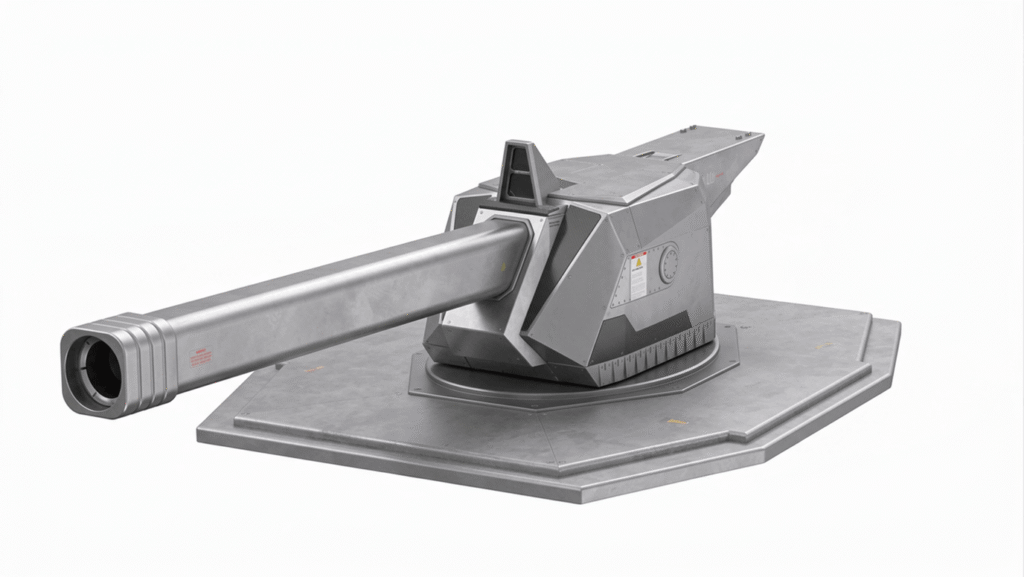
The railgun, a piece of ordnance that uses electromagnetic energy rather than chemical explosives to propel a projectile out of a gun barrel, is again in vogue amongst world navies.
The French navy made it a component of its proposed SCX-26 large destroyer. The Japanese continue to experiment with the weapon onboard their test ship Asuka. The Chinese placed a railgun on an aging landing ship as a test platform. And though the United States terminated its program in 2021, it is again considering the railgun as a shipboard armament for its proposed battleship.
While the weapon offers a much simpler magazine and 125-mile range striking power, railgun technology has been immature, with relatively short barrel life, excess heat distribution problems and a slow rate of fire that makes the weapon unsuitable for integrated air and missile defense.
So, what does the railgun bring in terms of firepower to U.S. Navy ships? Is it the basis for an electromagnetic dreadnought or is it a cool science project absent real application in naval warfare?
The railgun advantages
The railgun offers inviting characteristics for both warship operators and the budgeteers that must purchase them. Unlike a conventional gun, a railgun uses electromagnetic energy to propel its projectiles, thus relieving the need for a ship to store explosive propellant charges aboard.
This means two to three times more potential magazine space on the ship and less cost in procuring ammunition. U.S. Navy experimental railguns fired projectiles weighing 45 pounds at ranges of 50-110 nautical miles that hit with Mach 7.5 speed and capable of penetrating nearly all armor and hardened concrete bunkers. While the entry hole might be small, the sheer amount of kinetic energy transmitted to the target on impact can cause significant other damage to a target, especially a ship at sea.
The challenges in using a large railgun at sea, however, are significant.
The power requirement alone is daunting for nearly all current combatant ships. A railgun firing 12 rounds per minute requires 30 megawatts of electrical power, enough to power up to 30,000 homes.
While the U.S. Navy Zumwalt class destroyer might manage this as its integrated power system produces approximately 75 megawatts of power, the more numerous Arleigh Burke class ships produce only 12 megawatts, making them unsuitable for railgun upgrades in the absence of a significant upgrade in power generation capacity.
Railgun firing is also highly destructive to the weapon.
The intense heat and kinetic energy created in the electromagnetic firing process have caused significant damage to the gun’s rails and other components. This damage has in the past limited U.S. Navy railguns to a barrel life of less than two dozen shots. That’s not a tactically viable weapon for a modern warship and is in ways a throwback to the massive cannons of late 19th century warships like the ill-fated British warship HMS Victoria, whose 16.25-inch guns had a barrel life of under 75 rounds, considered a limiting factor even at the end of the 19th century.
Positive technical developments
But recent Japanese railgun tests, suggest that a much lighter-weight round could result in longer barrel life and greater tactical viability.
The Japanese railgun recently test fired on the test ship JDS Asuka fired a 40mm round weighing under one pound, a tiny fraction of the 155 mm, 45-pound projectiles fired from the U.S. Navy railgun. The Japanese system so far also requires much less energy, needing perhaps just five megawatts of power to fire its railgun. Large or small, railguns require a great deal of power to operate that is often at the limit or far beyond that of most current naval vessels to provide.
Such small projectiles might not significantly damage a ship, but if the barrel life of the Japanese weapon reaches 120-200 rounds, it becomes a tactically viable weapon system. If rate of fire also increases to 10 rounds per minute, the lighter Japanese 16 mm weapon could become a potential air and missile defense system. Even that system is bulky, with a reported four additional shipping containers mounted on the Asuka’s deck to facilitate at-sea testing.
In search of utility
The larger question is what roles railguns will play in naval combat given its limitations and whether the railgun is a very high-tech weapon system without a useful military mission.
Back before it was discontinued in 2021, the weapon’s barrel life was poor, excess heat dissipation was a challenge, and its nominal 110 nautical mile range was not long enough to engage missile-armed platforms before they could fire.
If used against surface ships, the railgun would also require a forward observation platform, a drone perhaps, to spot the fall of shot and report damage back to the firing platform. Even a railgun firing 10-12 rounds per minute as indicated by the Japanese experiment may be too slow for missile defense.
The Japanese experiments with a lower-power weapon and much smaller projectile suggest one path forward toward a defensive weapon against drones and aircraft at first. Larger railgun weapons require vast amounts of power, and a future “railgun battleship” firing perhaps three such weapons (one per turret) at once would require the power that only several nuclear reactors might provide.
Such a ship might, however, cause significant damage to opponents with just a few “broadsides” of such weapons and be very cost effective in service with nuclear power. But the U.S. would need to expend vast resources, shipyard space and upfront costs to create such a vessel.
One railgun, as seen on the French SCX-26 and U.S. BBGXN designs, may not be enough to provide dreadnought-level firepower. For the present, the railgun will remain a weapon in waiting, with perhaps its true potential just beyond reach.