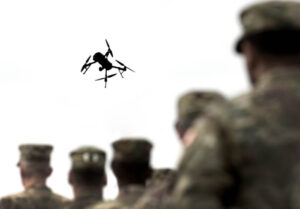

“Know the enemy and know yourself; in a hundred battles you will never be in peril,” wrote Sun Tzu in The Art of War.
More than two millennia later, the technology of warfare has changed beyond recognition, but the underlying strategic principle has not. You can only anticipate, plan and act effectively if you understand your adversary, your own capabilities and how the environment around you is changing. But today’s battlefield is vast, fast-moving and more complex than ever before.
Great-power competition between the United States and China, Russia’s war against Ukraine and growing geopolitical uncertainty have forced Europe to confront an uncomfortable reality: peace cannot be assumed, and sovereignty ultimately requires the ability to see, understand and act for itself.
Ukraine has also demonstrated how rapidly warfare is changing. Autonomous technologies and increasingly software-driven decision-making are compressing the time between observation and action. In this environment, information advantage becomes even more critical.
Earth observation provides a key part of this information layer. Satellites operate far above national borders and can observe enormous areas repeatedly. Optical systems provide rich visual information across multiple spectral bands.
Synthetic Aperture Radar (SAR) adds all-weather and night-time capability, while electronic intelligence and other sensors provide different parts of the picture. The real power emerges when these capabilities are combined into trusted intelligence.
A single image tells us what was there. Repeated observations tell us what has changed. And that difference matters. An exquisite image of yesterday’s battlefield is only history. You need timely insight while events unfold.
The advantage of constellations
This is where constellations come into play. They enable much shorter revisit intervals. Combine multiple constellations, sensor types, ground-based systems and drones, and military leaders can develop a dynamic picture across vast areas. Increasingly, onboard computing and artificial intelligence (AI) can identify relevant changes, reducing the time from observation, to information, to insight, to action.
The market provides compelling evidence of this shift towards constellation-level observation. In 2025, Earth observation (EO) overtook telecommunications as the largest revenue-producing satellite sector for Europe’s space manufacturers. European EO system sales were 24% higher than telecommunications sales, with the growth driven significantly by defense demand.
Historically, nations have developed small numbers of highly specialized satellite spacecraft. Persistent monitoring requires something different: constellations, rapid production, interoperability and resilience.
Providing Europe with better intelligence
Europe’s NewSpace approach – an industry-led and government-supported move toward cheaper, faster and more commercially driven space technology – has a key role to play in scaling Earth observation capability. Built on common architectures and shared interfaces, with component and subsystem providers serving multiple satellite manufacturers, this effort enables a shift from bespoke development towards scalable, value-driven products. Products can continuously improve with successive generations, lead times can shorten and cost efficiency can be designed in from the outset. This enables scale.
Importantly, common hardware deployed across multiple constellations also creates the potential for federation from the hardware layer upwards, rather than forcing interoperability down through system requirements. Using common payloads across different satellite manufacturers and fleets can make it easier to connect assets across constellations and sensor types, improving revisit, resilience and confidence in the resulting intelligence picture.
Europe already possesses world-class capability in optics, detectors, electronics, spacecraft, AI and advanced manufacturing. The challenge now is to connect and scale these capabilities into effective intelligence programs.
Sun Tzu’s battlefield was measured in miles, and information travelled at the speed of a messenger. Today’s battlefield can span continents and domains, while information travels at the speed of light.
The technology has changed completely. The strategic imperative to know your adversary has not.