“Si vis pacem, para bellum.” If you want peace, prepare for war.
At Thermopylae in 480 B.C., a small Spartan force held a mountain pass for days against the massive Persian army. They did not hold back a Persian force because of better equipment. They held because of a lifetime of training.
We have lost sight of that lesson and prioritize the people who buy equipment rather than the troops who use the gear. We under-train those troops on the equipment they already carry and punish honest mistakes.
Those themes ran through my recent conversation on the Impact Point podcast with Rep. Ryan, Zinke, R-Montana, a former Navy SEAL, where three topics kept coming up: training, risk and Pentagon procurement.
Start with training. “I can buy the best shotgun in the world,” Zinke told me, “but I’m not gonna be very effective unless I train with it.”
In my experience, people account for 50 percent to 70 percent of any military problem. Yet when a gap appears, our instinct is to buy something new, even when the system in hand “provides far more capability than you’re using,” as Zinke put it. Before we spend another dollar, we should have to explain what our current equipment cannot do.
Training is also the fastest gap to close. New technology “takes a lot longer to field and develop,” Zinke said, while the skills gap “can be approached and reached fairly rapidly, just on the training side.” That training can’t be reserved for elite units. It has to reach every service member, including the National Guard.
Procurement reform essential
Then there is how the Pentagon buys things. Its five-year budget plan, Zinke said, “is configured for a peacetime Navy or peacetime Army, where time isn’t of the essence.” Anyone who served in Iraq or Afghanistan remembers units scrambling for leftover year-end money to buy gear no one had budgeted for years earlier.
Meanwhile, companies chase long-term government programs that guarantee revenue, and by the time they win one the technology is often outdated. In Ukraine, drone technology can become obsolete within one to three months.
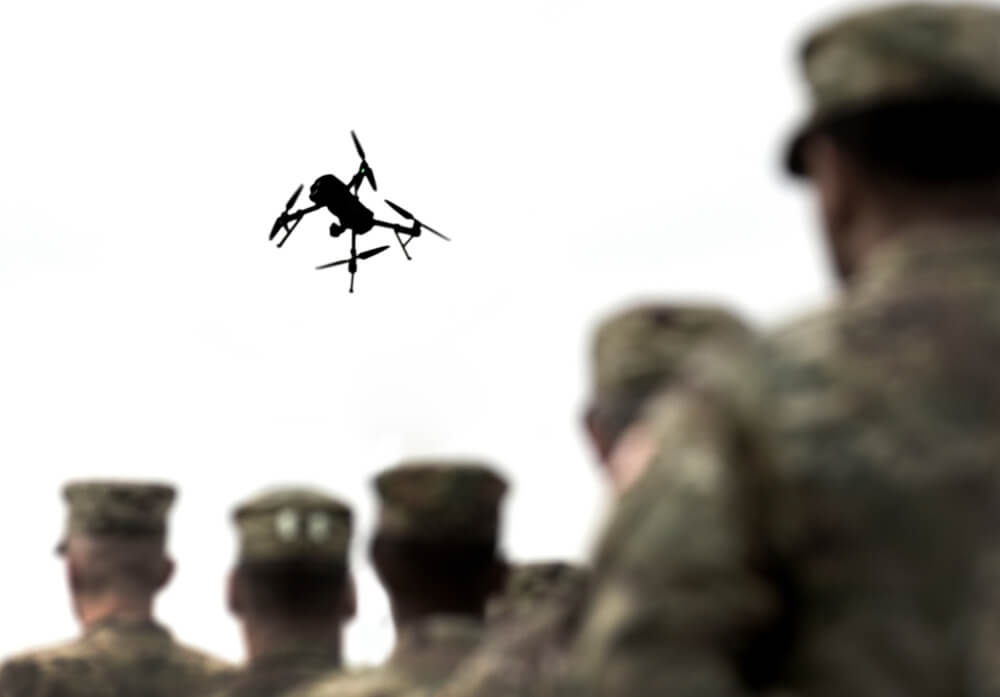
The threat won’t wait. Zinke noted that Iran builds roughly 500 to 600 Shahed drones a week. These are cheap, explosive-laden aircraft designed to fly one way into a target. One month of production could yield a stockpile of 2,000. No warship could fend off a well-coordinated swarm that size.
In March, the Army ordered more than 2,500 Skydio X10D scout drones, built to keep flying when an enemy jams their signals or GPS, for more than $52 million, according to the company’s announcement. That is roughly $20,800 per drone.
In Ukraine, one lawmaker argues that $25 million a year could buy 30,000 drones, or about $834 each, The Week reported. Ukraine’s homegrown scout drones sell for a few thousand dollars, and its roughly $500 attack drones now use artificial intelligence to stay on target even when jammed, according to Euromaidan Press. To be fair, the Skydio drone must meet strict U.S. cybersecurity and supply-chain rules, and those cost money.
But the bigger lesson is scale.
Ukraine went from building a few thousand small drones a year in 2022 to roughly 3 million in 2025, according to an analysis by Just Security. It did so by letting hundreds of private companies compete and improve their designs against the enemy in real time.
A $20,000 gap per drone should make every taxpayer ask whether layers of management, paperwork and contractor profit are giving us our money’s worth.
Connecting troops and weapon buyers
Zinke’s fix: put troops and manufacturers in the same room. “It’s important to have legal responsibility and transparency, but the operator and the manufacturer, we need to make sure they talk,” he said. Too often, the people deciding the roles equipment must perform lack understanding of what is needed in the field.
Underneath it all is risk.
“We are very risk averse because no one wants to be hung with a mistake,” Zinke said. An airplane that never leaves the hangar never crashes, he noted, but it never flies, either. His prescription: “Ultimately, you have to incur some risk, you have to trust people, and you have to give them some latitude in a very rapidly changing environment.” Accepting no risk is itself a risk.
Zinke is optimistic, and so am I. The Pentagon is reworking how it buys equipment, and front-line troops are starting to report that their voices are being heard. It takes time to turn an aircraft carrier, but it can be turned.
The standard should be the one Zinke closed with — never put troops in harm’s way “unless they have the right training, the right equipment and the right leadership to win decisively on the field of battle.”