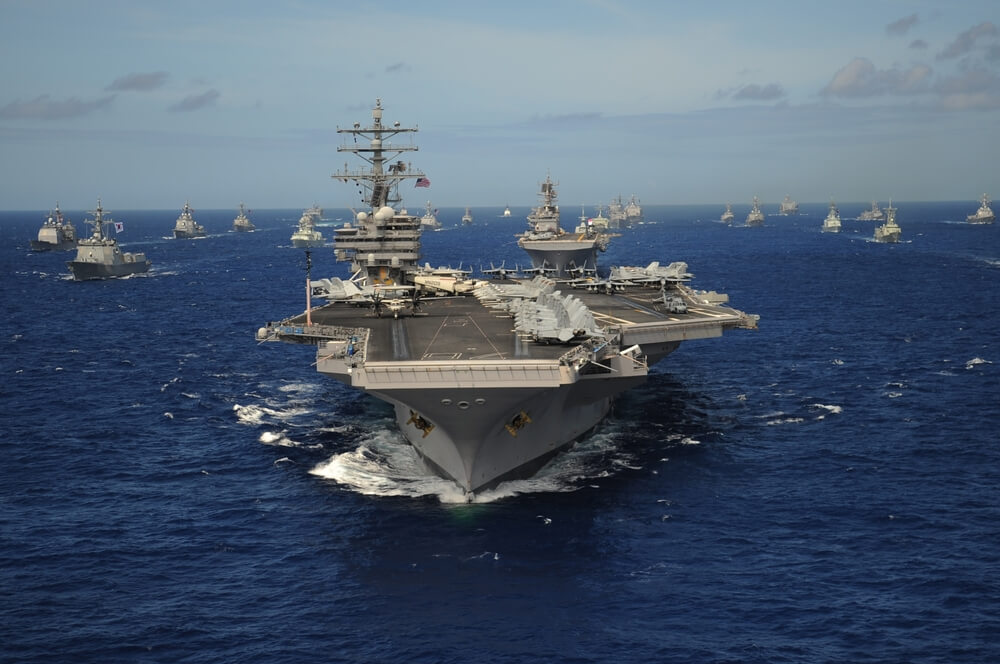
The most important naval lesson emerging from the ongoing conflict with Iran is the continuing value of aircraft carriers and their embarked air wings in delivering persistent combat effects inside Iran’s weapons engagement zone.
Carriers may not provide the preponderance of aircraft in every deployed conflict, but they often arrive first, remain less vulnerable than fixed land bases and frequently stay on station after Air Force units redeploy home. The Iran conflict also makes clear that the U.S. Navy needs 12 to 15 operational carriers to sustain long-duration missions such as the ongoing blockade of Iranian ports and the Strait of Hormuz. The Navy currently has 11 available aircraft carriers.
Carrier performance in Iran conflict
Carrier performance in the Iran conflict matters because it tests a long-running debate over whether large-deck carriers remain survivable, useful and worth their cost in a missile-rich theater. The available evidence does not settle every argument, but it does show that carriers still provide a mobile, sovereign and operationally flexible strike platform when land bases are exposed, politically constrained, or no longer sufficient.
While specific data on carrier air wing performance during the conflict is not yet available, several positive conclusions are emerging.
Carrier aviation was important enough to the original Epic Fury operation that its start on Feb. 28 was delayed until USS Gerald R. Ford was in position to launch airstrikes alongside USS Abraham Lincoln.
The Navy has lost no manned aircraft to date in its Iran operations and only one MQ-4C Triton drone, reportedly the result of an accident rather than adversary action. Many Air Force aircraft have already rotated out of the Middle East and direct involvement in combat operations, while USS Lincoln, soon to be replaced by USS George Washington, and USS George H.W. Bush remain deployed with their embarked strike fighter squadrons and other aircraft to enforce the U.S. blockade of Iranian ports.
Although Navy carriers have endured deployment lengths not equaled since the Vietnam War, those long periods on station underscore their value as mobile pieces of U.S. sovereign territory with sustainable strike capacity over a months-long campaign.
Not enough ships or aircraft
The fire aboard Gerald R. Ford and recent morale issues on Abraham Lincoln also show that the nation has too few large flattops to support multiple deployed locations and respond to crises such as the Iran conflict.
It was once presumed that three carriers in the inventory produced one deployed carrier: one on station, one in the shipyard after deployment and one in the training cycle preparing to deploy. The Navy’s 2003 shift to the Fleet Response Plan, driven by the George W. Bush administration’s desire to keep more carriers deployed, disrupted that planning model. The downstream effects of longer and more frequent deployments were never fully incorporated into Navy planning, and carrier readiness has continued to decline.
Today, it can take three to five flattops to generate one deployed unit because aging ships, extended deployments, deferred maintenance and slower major overhauls have combined to reduce the number of carriers available for forward operations.
Naval aviation has improved
Naval aviation has performed better by addressing severe readiness problems in frontline combat aircraft such as the F/A-18 during the 2010s through a dedicated effort to improve aircraft availability for deployment.
The impending deployment of the unmanned MQ-25A Stingray tanker should further strengthen the air wing by ending the costly practice of buddy tanking, in which F/A-18s were used as tankers to extend the range of a smaller number of strike aircraft.
Despite these improvements, the overall number of carrier-based aircraft is down, not because of readiness failures, but because of budget-driven reductions. Although the Navy possesses 11 carriers, it has only nine carrier air wings to support them. The most recent reduction, from 10 air wings to nine, was made in the 2023 defense budget on the peacetime assumption that only nine of 11 carriers would be available for operations at any one time because at least two would be in maintenance.
That assumption does not account for potential battle losses or the need to return additional flattops to immediate service in wartime. The progress made by naval aviation leaders in improving aircraft readiness over the last decade is therefore partly offset by the lack of available replacement aircraft, which matter as much as munitions in sustaining combat power.
The U.S. Navy is no longer a 10- or 11-carrier force operating in a 15-carrier world. Given the number of flattops now unavailable because of extended maintenance, it is closer to a seven- or eight-carrier force facing that high demand.
Three of its remaining carriers, Nimitz, Eisenhower and Vinson, are elderly, further reducing effective carrier capacity. The Navy doesn’t have enough carrier air wings to support all carriers, and the Navy has not adequately accounted for the long-term maintenance effects of extended deployments such as those of Ford and Lincoln.
Despite these challenges, successive presidents continue to ask, “Where are the carriers?” when the need arises. That question is unlikely to disappear, but the answer may increasingly come from a much-depleted force of carriers and air wings struggling to meet the call.