
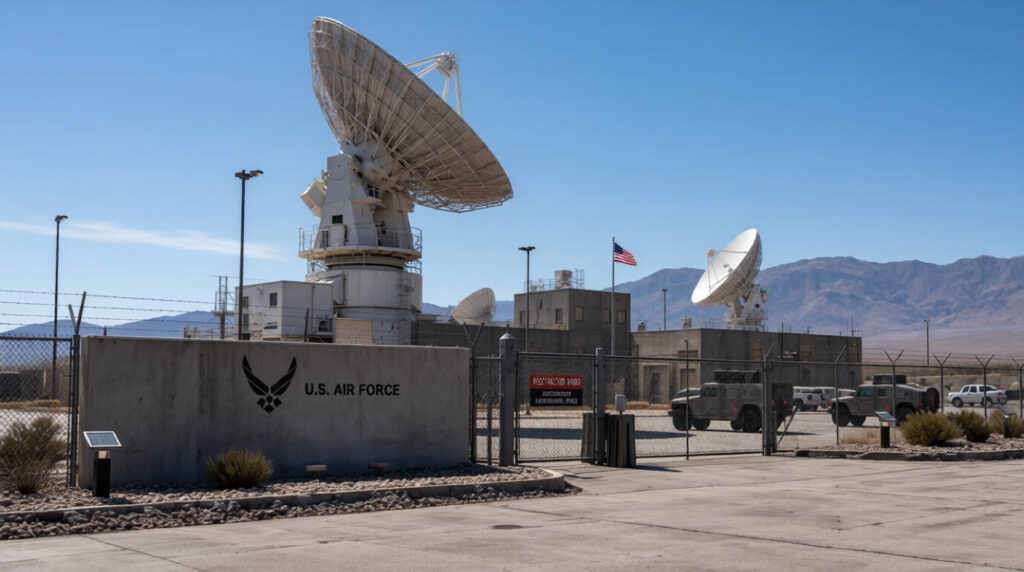
Recent military conflicts are revealing the vulnerability of fixed satellite communications (SATCOM) ground infrastructure – the access stations, networking, operations centers and other Earth-based equipment that are essential to the management and control of a complete satellite system.
In 2022, hackers attacked commercial ground-based systems at the onset of Russia’s invasion of Ukraine, disrupting internet connectivity throughout Europe. In March, at the start of the U.S. and Israeli Operation Epic Fury against Iran, satellite operator SES reported that a missile hit its teleport facility in Israel, damaging multiple antennae.
These incidents reveal that adversaries now consider commercial SATCOM infrastructure to be fair game during conflict; they also highlight gaps in protecting the ground systems upon which military operations increasingly depend. Hardening them is both urgent and vital to ensuring communications continuity for the most sensitive and critical operations.
Vulnerable ground equipment
One clear example is nuclear command and control. The equipment must guarantee that all key commanders and leaders stay connected to ensure response coordination and adversarial deterrence.
Beyond Line-of-Sight (BLOS) drone operations is another example. Unmanned aerial vehicles deployed in distant and remote battlefield environments require resilient connectivity to send clear video feeds and telemetry data back to on-base operators who need it for real-time decision-making.
Beyond defense, other agencies also have critical SATCOM-dependent requirements. For example, launching a NASA Artemis rocket depends on ground communications that are critical throughout the full mission operations timeline, from launch preparations through splash down and recovery.
Bolstering the weakest link
The space-based systems of defense satellite networks are traditionally the most vulnerable, largely because they consist primarily of geosynchronous (GEO) satellites. Successfully attacking even one or two satellites would have a significant impact on coverage. For GEO, that coverage could be as much as one-third of the planet.
Now, with the government’s mandate for federal agencies to adopt commercial technology, the point of greatest vulnerability is shifting away from space. The Defense Innovation Unit’s new Hybrid Space Architecture (HSA) integrates commercial and military space equipment and SATCOM to improve warfighter situational awareness and decision-making.
Security for the HSA has focused on space-based systems, employing edge computing, zero-trust architectures, data encryption and a proliferated multi-orbit network that includes medium Earth orbit (MEO) and low Earth orbit (LEO) constellations for signal path diversity and resilient real-time connectivity. This successful approach eases dependence on vulnerable GEO satellites.
A path to better security
Such depth of security must now be mirrored on the ground. There are three primary paths to ensuring resilient terrestrial network availability and access. A successful strategy integrates elements from each.
First is adopting network architectures that enable user terminals to communicate directly to other user terminals without relying on in-theater gateways. This mitigates the gateway attack vector and will limit the impact of attacking ground infrastructure in that theater.
The second path includes housing infrastructure on a military base to allow the same rigorous protection as any other on-base asset.
The third path involves deploying government-dedicated commercial assets that are transportable. Since fixed ground systems can be subject to adversarial surveillance, adopting portable infrastructure would allow defense agencies to land satellite data at protected military locations, but quickly move ground assets to different locations as needed.
For example, commercial private access stations could be made small enough to mount on the back of a truck and be relocated, even if just a few miles away, forcing an adversary to restart its search for them. This same model is used with mobile missile launchers to great success. While they would remain commercial SATCOM infrastructure, dedicating them to government use will allow agencies to take the protective measures it deems necessary to secure them.
With its enthusiastic embrace of multi-orbit capabilities and pursuit of flexible terminal programs, the Pentagon is making progress in protecting communications infrastructure. Now, leaders must turn to protecting ground systems and minimizing their vulnerability