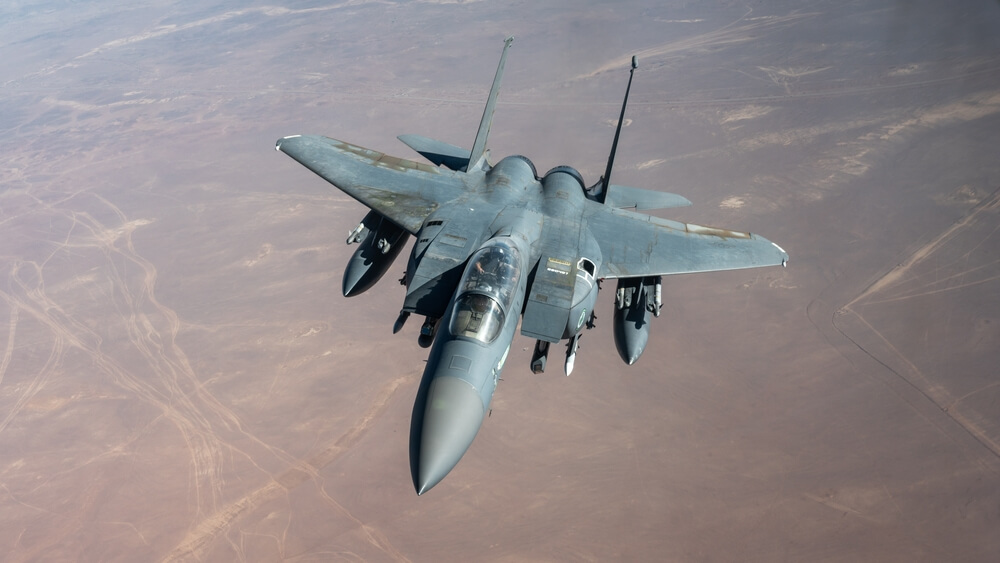
Somewhere over Kuwait during the dense barrage phase of Operation Epic Fury, Kuwaiti air defense operators tracking a cluttered radar picture identified a flight of three U.S. F-15E Strike Eagles as inbound Iranian threats and engaged them.
Kuwait shot down all three aircraft. All six crew ejected safely and were recovered.
That event was quickly overshadowed by the headline results of Epic Fury: Iran’s ballistic missile arsenal heavily degraded, thousands of military targets destroyed, key nodes of the nuclear infrastructure in ruins. By any conventional measure, the operation succeeded.
But the friendly fire incident underscored a structural failure and the predictable outcome of coalition forces fighting a single battle from multiple, unconnected air pictures. The lesson buried in the Kuwait incident and in the punishing rate at which coalition forces burned through interceptors across the engagement is one the defense community has been slow to absorb — in modern air and missile defense, the command-and-control system is not infrastructure. It is the primary weapon.
The real cost of fragmented command and control
The standard framing of the air and missile defense problem focuses on interceptors: how many Patriots, how many Standard Missile 3’s and how many Terminal High Altitude Area Defense rounds remain in the magazine. These metrics matter. But they are downstream of a more fundamental variable: how efficiently a force uses the interceptors it has.
Efficiency in air and missile defense is a command-and-control problem. A fragmented air picture where each battery or national element sees its own radar picture but cannot share fire-control-quality tracks in real time produces duplicative engagements. Two batteries engage the same threat. A shooter with an inferior track fires when a better-positioned shooter should have.
During Epic Fury, these inefficiencies were not occasional anomalies; they were systemic. The coalition’s integrated air and missile defense architecture, such as it was, consisted of national systems operating in parallel rather than jointly. Each partner saw its own picture. None could see everyone else’s in the time and fidelity required for coordinated fire control. The result was that interceptors were consumed at rates the industrial base cannot readily sustain, not because the missiles failed, but because the command architecture multiplied engagements unnecessarily.
Friendly fire dangers
The fratricide risk is the sharpest expression of the same problem. When national air pictures do not share track data in real time, and when friendly aircraft maneuver through a dense engagement without being visible in every defender’s common operating picture, the conditions for misidentification are structural.
The Kuwait incident was not operator error. It was the architecture producing the outcome it was designed to produce. Kuwaiti operators followed their procedures correctly. Their procedures just assumed a coherent, shared air picture that did not exist.
This is the lesson Epic Fury has supplied, and it is not a new one.
Variants of the same fragmentation problem have appeared in every major coalition air and missile defense engagement of the past three decades. What is new is the scale at which it now manifests, and the adversary’s explicit awareness of it.
Iran’s salvo strategy during Epic Fury was designed in part to exploit command and control seams or to saturate the engagement space at a rate that would overwhelm uncoordinated defenders even when each individual battery performed competently. The operational design assumed, correctly, that coalition forces would be fighting their own air pictures rather than a shared one.
Part II addresses the architecture that already exists to close this gap and why the acquisition system has yet to field it at the scale the requirement demands.