
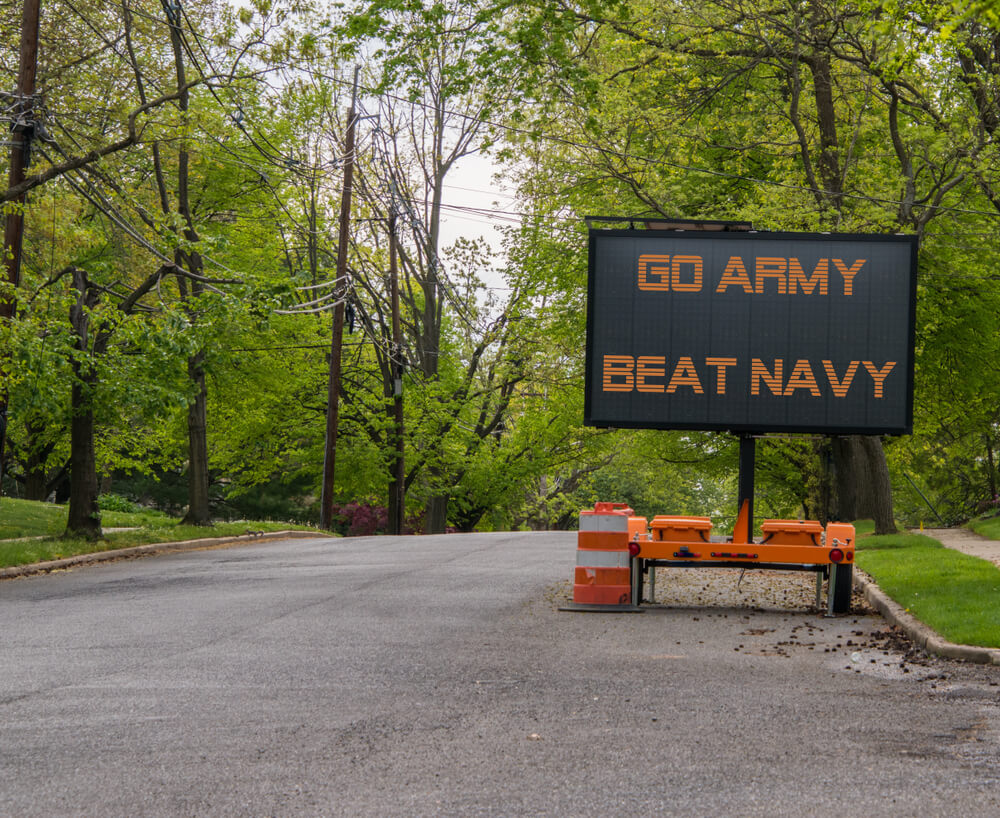
In our nation divided, fraught with influencers and fractious politicians who focus on settling scores rather than seeking compromise, one annual ritual stands out as a kind of therapy.
The Army-Navy football game (on Dec. 13) is much more than your standard gridiron battle. Rather, it is a competition between young Americans for whom the outcome of the game is incredibly important, but not nearly as important as what comes afterwards – service to the nation.
Navy Midshipmen and Army Cadets have scratched and clawed their way to attend their respective service academies, not for sports glory, but for the opportunity to be military officers. These athletes won’t be wined and dined by scouts looking to sign them to multi-year deals. No million-dollar endorsements await them at graduation. What is waiting for them is training – to be platoon leaders, pilots, submariners, surface ship warriors or special operators.
Ultimately, they swear an oath to the Constitution, to serve and defend. They deploy around the world, and they fight in our conflicts and wars. They represent the ideas and ideals that the nation was founded upon, but that currently seem lost for so many.
On the same team
The Midshipmen and Cadets will soon be operating on the same team—in highly dangerous environments where they must work together, depend on one another, fight next to each other and find solutions together. They must do what seems too hard for so many Americans by putting ego aside for the success of the mission.
The military academies are not without their issues. In recent years, they have been dogged by cheating and sexual assault scandals. What’s more, the military in general is something of unknown terrain for so many Americans, given that only a small percentage of the country serves in the all-volunteer force.
And yet the Army-Navy rivalry on the football field transcends and prevails. When the country is polarized, these institutions, with their academic excellence and storied histories tethered directly to the nation’s freedom and core beliefs, give us hope.
In the era of the ubiquitous internet troll or politician for whom disagreement is a blood sport, the fierce competition of the Army-Navy rivalry exists side-by-side with equally fierce respect. Those who are competing do so knowing that the game is almost incidental, that soon enough they will be together enlisted in the same cause.
Correction and compromise
I did not attend a military academy. No matter. I believe in the spirit of the game. For me, the Army-Navy game exemplifies what needs correction in our American culture writ large.
Correction won’t come about without compromise. For those who believe that the U.S. has traveled beyond a Rubicon from which there is no return to civility, recent polling suggests otherwise. Americans, whatever their party affiliation, overwhelmingly agree on a range of issues reflecting the central aspects of our fragile democracy. These include compromise and a rejection of political violence.
“Disagreement is good because competition is good,” said Arthur C. Brooks, the social scientist and commentator. “It makes us sharp and strong, whether in sports, in politics, in economics, or in the world of ideas. We don’t need to disagree less; we need to disagree better.”
The Army-Navy rivalry points the way to a more civil and hopeful future of disagreeing better and then, once the argument is over, working together for something worth defending.