
The Indo-Pacific is the most strategically vital and contested theater of the 21st century. Its vast geography and escalating threat environment demand faster and more informed decision-making.
Supporting U.S. forces requires the Hawaii-based U.S. Indo-Pacific Command (INDOPACOM) to modernize networks, data environments and coalition structures. It must also enhance cybersecurity strategies to achieve decision dominance by 2027 and beyond.
Significant complexities inherent with the Indo-Pacific present unique challenges. Unlike NATO’s integrated framework, Indo-Pacific alliances rely on bilateral structures. For example, information often flows indirectly from Japan to the U.S. to the Republic of Korea, creating friction and slowing decision cycles. Moreover, information is dynamic, so one major hurdle to achieving data dominance is ensuring that all nation partners have access to relevant, accurate and up-to-date information.
The potential risk of a large-scale conflict in the Indo-Pacific remains elevated with growing consensus among foreign policy experts and intelligence assessments that the next two years will be a critical period for regional security. A case in point: China’s accelerated military modernization timeline targets combat-readiness for a Taiwan invasion by 2027.
The situation is exacerbated by the “tyranny of distance” with the large expanse of the Indo-Pacific, complicating logistics, command and control, communications and decision-making. The region’s vastness demands resilient communications, edge data access (allowing troops to process data directly in tactical environments), cloud and artificial intelligence (AI) integration and distributed and flexible architectures – all of which must occur in a secure environment.
The threat landscape
Aggressive gray-zone tactics—including economic, legal and information warfare—are a hallmark of the Chinese Communist Party (CCP). China uses cyber intrusions, electronic warfare, space-based disruption and disinformation to weaken decision-making and erode coalition cohesion.
U.S. officials and intelligence agencies have confirmed that China — whose tech prowess lies in exploiting dual use technology — conducts cyber campaigns targeting U.S. critical infrastructure, including transportation and communications systems that could disrupt military supply lines in a potential conflict.
To best respond to the threat landscape, the U.S. should consider lessons from the Russia–Ukraine conflict that underscore the need for rapid data-sharing, resilient networks, integration with autonomous systems and AI-enabled decision support to increase lethality. These takeaways are amplified in INDOPACOM due to distance and contested terrain.
Any conflict in the region will also present a risk to the homeland. Pacific conflicts will involve cyberattacks on U.S. networks, data systems and disruption of domestic systems – creating additional strain in maintaining connectivity with forward forces already impaired by distance.
Modernization imperatives
Modernization requirements for decision dominance include a “zero trust” cyber defense, coalition interoperability, speed through innovation, mission-ready resilience and an effective mechanism to move from concept to capability. Zero Trust requires continuous verification of all users, devices and workloads.
To build a zero-trust cyber defense, distributed operations must have identity-based access, micro-segmentation and continuous verification across widely dispersed networks.
Interoperability is critical as future operations depend on rapid, secure, selective information sharing among diverse partners and environments. Consequently, cross-domain data solutions are fundamental, requiring the Department of Defense to securely transfer information between networks with different security levels using hardware and software with protocol breaks, content filtering and validation.
Innovation must accelerate in areas such as: artificial intelligence and machine learning; digital twins and modeling (virtual representation of a physical object, process or environment); software-defined networks; and, autonomous experimentation across domains.
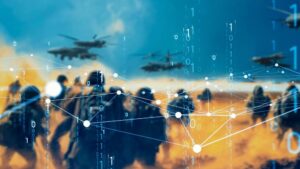
These will enable the military to perform real-time battlefield data analysis, accelerate decision making and improve situational awareness through local data processing with reduced latency. Above all, distributed forces must maintain cyber defense, visibility and responsiveness despite adversary disruption or degraded conditions.
It is essential to have a robust infrastructure and expertise to bridge concept and capability. Innovation or artificial research and development labs allow government and mission partners to test technologies against realistic conditions that prioritize the warfighter experience.
Moreover, adoption of so-called MOSA standards – a modular open systems approach that empowers affordable acquisition and design and AI agentic solutions–allows non-traditional providers to make meaningful contributions, break down barriers and simplify data sharing across services and coalition partners.
The path forward
The fight will be won by the side with decision dominance, the side that accesses, synthesizes and acts on information the fastest, even across thousands of miles. China’s strategy assumes slowness of coalition response. A modernized decision enterprise with speed and interoperability strengthens deterrence and reduces escalation risk.
To effectively support U.S. forces, strategic priorities for INDOPACOM include: modernizing networks and data fabrics for contested, distributed operations; establishing robust, scalable coalition-ready architectures; expanding adoption of automation, digital engineering and AI; strengthening cyber resilience at every echelon; and, increasing prototyping, experimentation and rapid integration to bridge concept and capability.