
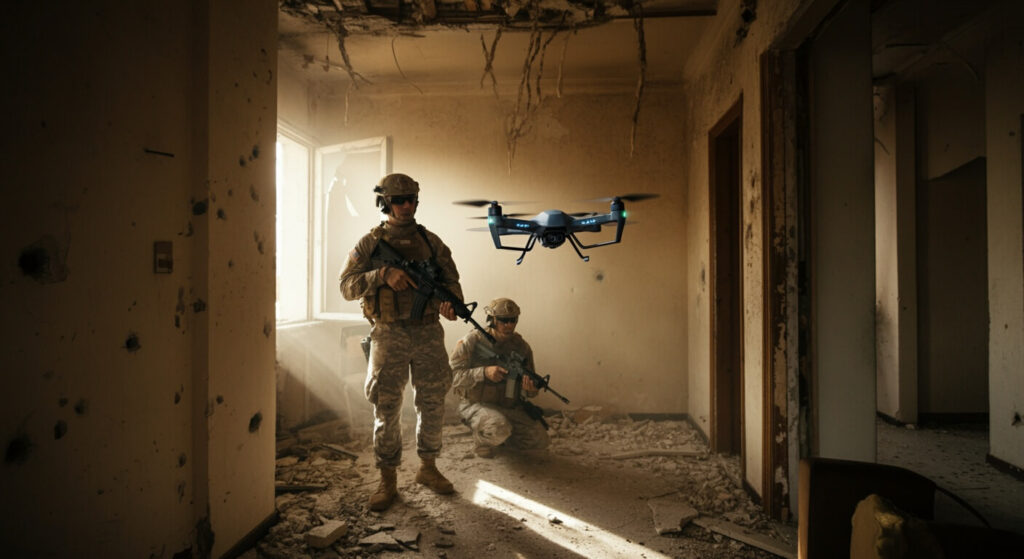
In Ukraine, a seismic shift is underway. Not only in the new weapons being deployed, but in the blurring of the line between consumer and defense technology.
Brave 1 is an online platform described as an “Amazon-like marketplace” for Ukrainian Defense Forces. Driven by a gamification layer, units earn points for verified kills which they then redeem for drones and gear. It’s a surreal, gamified vision of warfighting, where combat performance is reduced to scores, credits and real-life loot boxes.
Yet it works, especially with a generation of soldiers raised on gaming and online marketplaces. An open platform with ratings, reviews and competition brings procurement into the real-time feedback loop of the battlefield.
The system has reinvented decentralized procurement at every level, and it could point the way forward for Pentagon, which has struggled to develop weapons on contracts measured in years if not decades.
Exquisite defense tech will always have a place in satellites and intercontinental missiles, but it cannot scale to the pace of modern conflict. What does scale is commercial technology because it is accessible, affordable and adaptable.
Commercial technology
Brave1 is just one sign of a deeper realignment.
Cutting-edge battlefield tech once came from a black box, locked behind export restrictions and deep inside defense contracts. Today, many of those same components are a click away, erasing the moat between military-grade secrecy and consumer accessibility.
Artificial intelligence guidance modules that use computer vision to navigate to targets, fiber optic spools that make drones invincible and anti-jamming GPS arrays are all available on sites like AliExpress and Temu. Using commercial off-the-shelf parts, actors both friendly and hostile, can now make better drone systems than legacy defense primes. Battlefield innovation is now driven as much by procurement as invention.
Washington is taking notice.
A group of tech industry executives were sworn in as U.S. military officers in 2025 with the hopes of fusing the techno accelerationist mindset of Silicon Valley with the Department of Defense. And while the U.S. Army recently announced the rollout of a centralized online marketplace to streamline unmanned systems procurement, it remains to be seen how quickly it will be operationalized.
New defense tech companies have been vital contributors to the Army’s transformation initiative, designed to equip our soldiers with the best drones in the world. But we need to make these weapons accessible at a far faster pace than our current systems allow.
Traditional acquisition cycles stretch so long that the battlefield has already moved on by the time a system is fielded. For example, I’ve seen systems that meet the specs of a request for proposals but don’t meet the ever-evolving requirements of the warfighter because those needs change at such a rapid pace.
Meanwhile, on consumer marketplaces, any unit can find readily available parts at the quantity they demand. That underscores the point: innovation and engineering alone don’t win – it must be paired with adaptability and velocity.
From my experience, that’s how innovation happens __rapid feedback loops and real-world testing of the best ideas by end users. If we want to maintain American drone dominance and enhance mission effectiveness, the default posture should be letting the best technology win, even if born outside of traditional RFPs.
A recipe for success
Here’s what we need from policymakers and military leadership to make this a reality:
— De-risk commercial entry: Pre-qualify suppliers swiftly with small pilot buys that can be scaled if successful.
— Create accessible requirements: Let commercial innovators compete alongside large primes.
— Scalable gamification: Embedding a performance-based credit system could drive smart operations and innovation.
The future of military innovation will not come from legacy programs but will instead be built on the same principles that fuel commercial platforms: speed, iteration and accessibility.
The next war won’t wait for us to catch up. From Ukraine’s Brave1 marketplace to parts for Iranian drones sold openly on e-commerce sites, tomorrow’s fight will be defined by how quickly and cheaply technology reaches the front. Only by embracing commercialization can America’s defense industry keep pace with adversaries. Fall behind and we forfeit.