
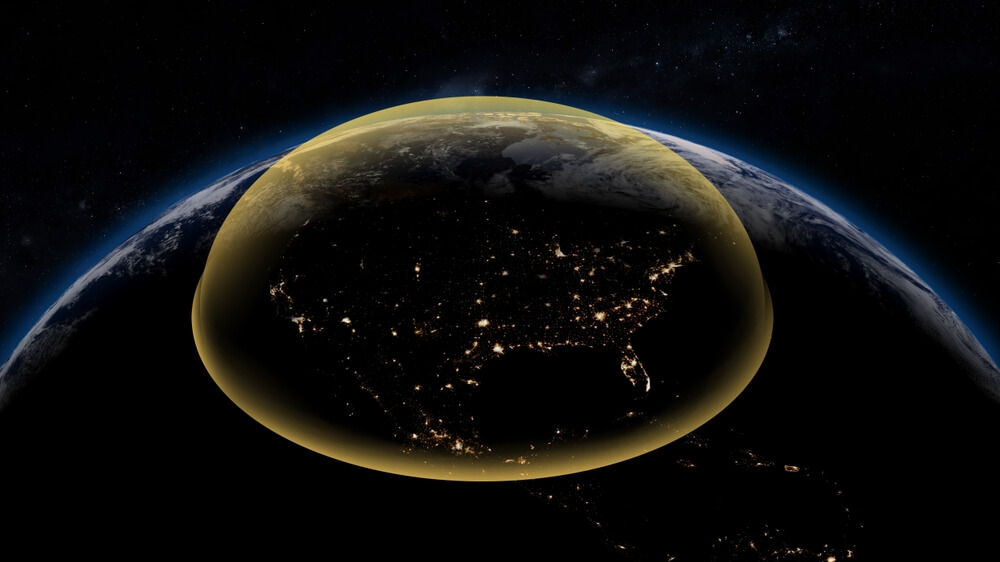
Defending the entire U.S. against Intercontinental Ballistic Missiles (ICBMs) armed with nuclear warheads is a complex technical issue. Yet Americans are asked to spend significant tax dollars for something so complex that most people would need to read a long scientific article to even begin to grasp. So, let’s boil this down to something a layman can understand.
In 1983, President Reagan proposed a Strategic Defense Initiative (SDI), nicknamed “Star Wars,” similar to President Trump’s “Golden Dome” proposal. After years of scientific endeavor costing $30 billion, the program was deemed technologically unattainable and terminated, while some of its technology migrated into other missile defense systems that eventually joined the U.S. arsenal.
Begun during the George W. Bush administration, a Ground-based Midcourse Defense (GMD) system, a limited option to protect the U.S. against small-scale attacks from rogue states like North Korea and Iran, has cost $63 billion to $70 billion, so far. To avoid a nuclear arms race, officials have emphasized GMD is not designed to defend against massive attacks from Russia or China.
The Missile Defense Agency has achieved significant success developing a layered system of land-and sea-based missile defense systems that could guard against this lower-level threat. But considered highly capable in regional theater defense, the current system has a lower confidence success rate against advanced ICBMs in tests and is viewed more as a limited deterrent than a foolproof shield.
Enter Golden Dome
In January 2025, President Trump issued Executive Order (EO) 14186 proposing a national missile defense shield nicknamed Golden Dome.
The EO, among other things, specified the system architecture shall include plans for “defense of the United States against ballistic, hypersonic, advanced cruise missiles and other next-generation aerial attacks from peer, near-peer and rogue adversaries; development and deployment of capabilities to defeat missile attacks prior to launch and in the boost phase; and development and deployment of proliferated, space-based interceptors.”
President Trump’s original goal was to achieve initial operating capability in three years at a cost of $185 billion. The Pentagon currently plans for an initial test in 2028, and about a decade to field a system.
Contrast that magical thinking with a new report from the nonpartisan Congressional Budget Office (CBO), which estimates the Golden Dome will probably cost about $1.2 trillion to develop, deploy and operate over the next 20 years. That’s six and a half times the president’s estimate and would likely cost significantly more.
The commander of the U.S. Space Command has challenged the CBO saying that it did not assess the system as currently envisioned. While the criticism is accurate, the reason is because the Pentagon has not made public the elements of that architecture. So, to meet a congressional demand for cost estimates, the CBO had to base its analysis on requirements established by the White House in the executive order.
Space-based interceptors— the holy grail
The Star Wars program demonstrated that national missile defense is only possible if a constellation of kinetic or laser interceptors can be deployed in space to destroy missiles, either before launch or during their boost phase when they are moving slower and present a greater heat signature. The difficulty in intercepting missiles becomes exponentially more difficult otherwise.
Interceptors on satellites in low Earth orbit would have to be extremely numerous, raising the cost. And due to orbital physics, there would be gaps when any given enemy launch site would be out of range of interceptors. This was the physics problem that killed the Strategic Defense Initiative. In addition, placing interceptors in space would cross a huge red line possibly leading to an arms race in space.
Metaphors such as shields or domes, combined with a lack of publicly available information and a limited general understanding of how missile defense works, perpetuate the illusion that with enough time and money, technology will advance to enable protection against all threats. But technology capable of defeating large numbers of incoming missiles at once in any reliable way is not in the bounds of the possible, at least at present.
Just like the mythical holy grail, it is unlikely to be found.
Golden Dome unlikely to work
Golden Dome is a dream that won’t come true. But we can still end up wasting a lot of money on it trying to defend against ICBMs, not the significantly easier intermediate- and short-range missile threat faced by Israel’s Iron Dome, which has caught the fancy of many in Washington.
As conceived, Golden Dome is unaffordable, technologically unachievable and strategically destabilizing because opponents can deploy more offensive capability at less cost than defensive systems.
The investment worth making is buried in the Golden Dome’s budget documents. Some of the Golden Dome funding apparently will help to address gaps in the GMD system. This includes. a limited interceptor inventory, an inconsistent ability to distinguish real warheads from decoys, a heavy reliance on an aging sensor network with geographic gaps in threat detection and the need for a more reliable command and control network.
Taken together, these will improve our ability to defend against limited rogue state attacks.