
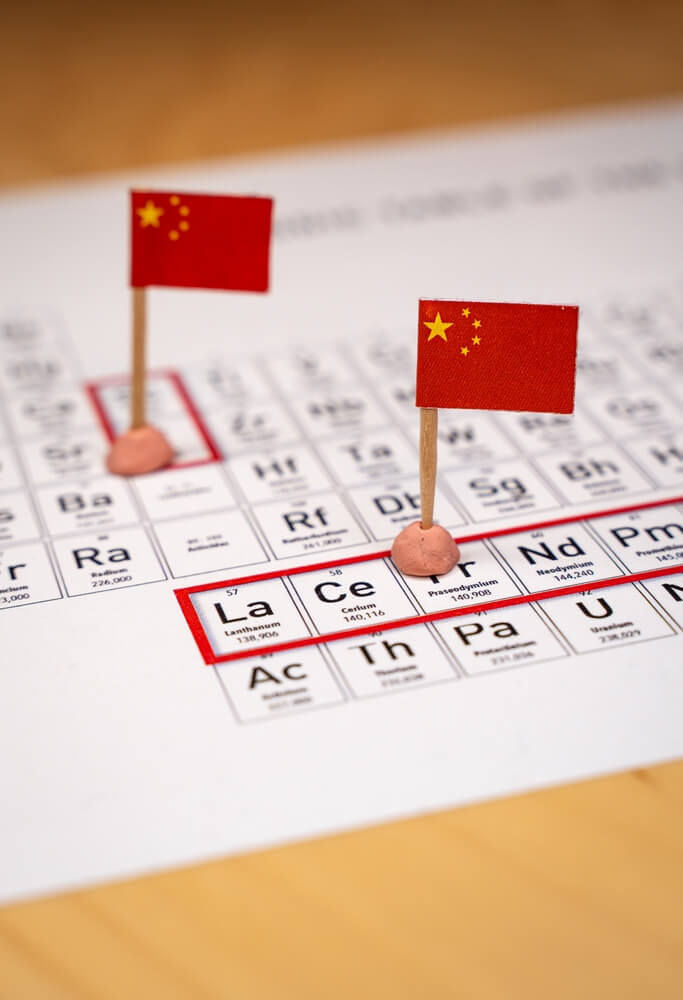
When China imposed export controls on heavy rare earths and permanent magnets in April 2025, the disruption that followed was not the cause of the West’s vulnerability—it was the symptom. Allied defense supply chains quickly stalled, exposing a structural dependence that more than three decades of Chinese industrial policy had quietly built.
This dominance is no accident. Over the past 30 years, Beijing has built a vertically integrated system spanning extraction, separation, refining, metal-making and permanent magnet production. According to research by academics from The London School of Economics and Birmingham University in the UK, China accounts for roughly 60% of global rare earth extraction, 87% of processing, 91% of metal production and 94% of permanent magnet manufacturing. The dominance is concentrated precisely where the chain is most complex and valuable—and where Western capacity has withered.
State subsidies, price manipulation and market flooding have done much of this work. By driving prices down over decades, Beijing forced non-Chinese processors out of business, leaving Western firms dependent on Chinese intermediates, equipment and process know-how. Importantly, rare earths themselves are not geologically scarce; the chokepoint lies in the structure of the value chain, not the availability of ore.
China holds the cards … for now
That leverage is no longer theoretical. In April 2025, citing national security, China imposed export controls on heavy rare earths, permanent magnets and related technologies. European Parliament research found that the new licensing regime was opaque and selective, slowing shipments and creating uncertainty across global supply chains.
A second wave of restrictions in October 2025, tightened access further and—critically—extended controls to foreign-made products with Chinese inputs. That extraterritorial reach signalled Beijing intent to police its supply chain wherever its materials end up.
The consequences were immediate. The April 2025 restrictions triggered rapid disruption across allied defense and industrial supply chains, exposing the fragility of systems still dependent on Chinese processing. Production slowdowns rippled through defense electronics and precision-guided munitions, where neodymium-iron-boron magnets and heavy rare earth additions like dysprosium and terbium are non-substitutable. The episode demonstrated that even temporary licensing delays can halt production when no alternative processing capacity exists.
A major structural challenge
For Western defense planners, the challenge is structural, not logistical.
Mining rare earths is only the first step. Producing defense-grade metals and magnets requires multi-stage chemical and metallurgical processes that take years to develop, qualify and scale. Many existing Western facilities still rely on Chinese-made equipment, spare parts and proprietary process knowledge—each one a separate point of vulnerability.
It is tempting to read China’s export controls as a strategy to keep the West dependent, but in truth China is consuming a rapidly growing share of its own rare earth output to feed domestic priorities— from electric vehicles to advanced weapons systems. As domestic demand climbs, Beijing’s incentive to maintain export volumes falls. EU Parliament analysis notes that China’s roughly 90% share of global rare earth refining is “unlikely to change” in the near term. Building an allied defense supply chain on the residual material China doesn’t consume is not a coherent strategy.
The West is responding
Western governments have, belatedly, begun to respond. The U.S. has deployed billions of dollars in financing, price floors and guaranteed government offtake, alongside new partnerships with Australia, Japan, Malaysia and Saudi Arabia to rebuild processing capacity. The central challenge now is execution: standing up and qualifying new facilities, attracting private investment and sustaining output through inevitable price cycles.
The big lever is regulatory. In January 2027, U.S. rules prohibiting Chinese-origin rare earth materials in American weapons systems take effect, with strict compliance requiring defense contractors to demonstrate that no Chinese-processed material enters their supply chains.
Given China’s dominance in refining and metal production, meeting that bar will be extremely difficult without rapid expansion of compliant alternative capacity—and the runway is short.
Securing independent rare earth processing has become a strategic imperative for defense readiness and operational autonomy.
The combination of Beijing’s entrenched dominance, its demonstrated willingness to wield export controls as leverage, and the tightening of U.S. defense procurement rules leaves Western nations one path forward: accelerate the rebuilding of the full rare earth value chain—from ore to finished magnet.
Where there are disruption and regulatory change, there is opportunity.
Forward-looking participants in the defense metals supply chain are scaling operations to meet the new regulatory architecture and the state financing now flowing into the sector. The long-overlooked foundation of modern defense manufacturing is finally getting the attention it requires. The question is no longer whether the West rebuilds this capacity, but how quickly—and who builds it.